 Skip to content
A content approval workflow keeps your content clear, trusted, and ready to publish. It also stops the weird little mess that happens when five people review one draft at once. You know that feeling, right? The draft looks fine, then feedback starts flying like loose papers in a storm.
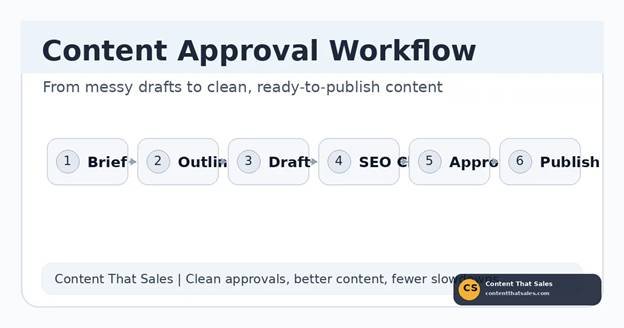
The good news is simple. You do not need a giant process. You need a clear path. That path tells each person what to check. It also says when to check it. That alone removes half the drama. At Content That Sales, we treat approval like a guardrail. It should protect the work. It should not slow the car.
This guide gives you that guardrail. You will get the stages, roles, checks, AI Overview notes, and a ready workflow.
What Is a Content Approval Workflow?
A content approval workflow is the step-by-step path content follows before it goes live. It covers who reviews the work, what they check, and when they approve it. That sounds basic. Still, most content problems start right here. A team may have a writer, editor, SEO lead, client, and manager. Each person sees the draft from a different angle. That can help a lot. It can also turn one clean draft into a tangled ball.
A real workflow stops that tangle. It turns review into a relay race. Each person gets the baton at the right time. A strong workflow usually includes these parts:
- A clear brief before writing starts
- An outline check before the full draft
- A draft edit for clarity and structure
- An SEO review for intent and links
- A fact check for claims and sources
- A brand review for voice and trust
- A final publish check before upload
The workflow is not there to make people feel important. It exists to protect the reader. If the reader gets a sharper page, the workflow worked.
Why Most Content Approval Breaks Down
Content approval breaks when nobody owns the next step. Everyone has comments. Nobody has a clear job. That is how small edits become big delays. One person wants more keywords. Another wants softer language. A third person asks for a full rewrite two hours before publish. That is not approval. That is a traffic jam.
The usual problems look like this:
- Too many people review the same thing
- Feedback arrives in different places
- Nobody knows whose comment wins
- Brand voice gets checked too late
- SEO gets bolted on after writing
- Legal review starts after design
- The final approver changes the goal
Sound familiar? The fix is not more meetings. The fix is a tighter system. Good approval feels calm. Everyone knows their lane. The writer knows what matters. The editor knows what to cut. The SEO lead knows what to check. A stitch in time saves nine. That old line fits content work perfectly.
Approve the brief early. You avoid a full draft repair later. Approve the outline early. You avoid moving entire sections later. Approve the final only after the small checks pass. That keeps pride in the work without adding panic.
The Best Content Approval Workflow for 2026
The best workflow is not the longest one. It is the clearest one. For 2026, content needs two jobs. It must help humans fast. It also must make sense to AI search tools. Google says its Search AI features use normal SEO foundations. The page still needs helpful text, strong links, and crawlable content. That matters for AI features in Google Search.
So your approval flow must check humans and machines. Not in a robotic way. More like a good host checking the room before guests arrive. Here is the workflow I would use for most teams.
1. Brief Approval
Start with the brief. The brief decides the goal, reader, keyword, angle, links, and CTA. Do not let writing start with a foggy brief. Fog creates fog. Use our guide on how to brief a content writer if your briefs feel thin.
2. Outline Approval
The outline is the cheapest place to fix strategy. Move sections now. Add missing questions now. Cut weak ideas now. Once the draft exists, edits cost more time.
3. First Draft Review
The editor checks flow, clarity, voice, and usefulness. This is not the SEO pass yet. First, make the draft worth reading.
4. SEO Review
The SEO lead checks search intent, headings, internal links, meta data, and topic gaps. This is where keyword research earns its keep.
5. Trust Review
The team checks claims, proof, examples, sources, and any risky statements. This step matters more now because AI tools can amplify weak claims.
6. Final Approval
The final approver checks readiness, not personal taste. That line matters. Approval is not a second writing round.
Who Should Approve Content?
Not everyone should approve content. Everyone can share input. That is different. A clean workflow separates reviewers from approvers. Reviewers improve the draft. Approvers decide if it can move forward. The main roles usually look like this:
- Content owner: Owns the goal and final decision
- Writer: Creates the first draft from the brief
- Editor: Fixes clarity, flow, and voice
- SEO lead: Checks intent, keywords, links, and SERP fit
- Subject expert: Checks truth and missing details
- Legal or compliance: Reviews risk when needed
- Publisher: Uploads, formats, and checks the live page

A small team can combine roles. That is fine. The trick is to keep the decision rights clear. One person should not rewrite because they feel nervous. Another should not block publish because they dislike one phrase. Ask this before adding an approver: Does this person lower real risk or improve real value?
If yes, add them. If no, keep them informed only. This is also why vetting matters. A strong agency already has clear roles. If you are unsure, read how to vet a content writing agency in 30 minutes before you hire. A good team does not need a crowd around every draft. It needs the right eyes at the right moment.
Build Your Workflow Around Risk Levels
Not every content piece needs the same approval path. A simple blog update does not need legal review. A finance landing page may need several checks. A casual social post needs speed. A medical page needs proof and care. So build risk levels.
Low-Risk Content
This includes simple blog updates, glossary pages, and light edits. Use a short path:
- Writer updates the piece
- Editor checks clarity
- SEO checks links and title
- Publisher sends it live
This keeps small work moving.
Medium-Risk Content
This includes new blog posts, service pages, and lead pages. Use a fuller path:
- Brief approval
- Outline approval
- Draft edit
- SEO review
- Brand review
- Final publish check
Most blog post writing should use this level.
High-Risk Content
This includes legal, health, finance, claims-heavy, or offer-heavy content. Add extra checks:
- Expert review
- Legal review
- Source review
- Compliance notes
- Final owner sign off
This is not about fear. It is about trust. Readers can feel when a page has been checked. It reads steady. It does not wobble. A risk-based flow saves time because it avoids over-reviewing simple work. It also protects serious work from weak claims. That balance matters.
How to Approve the Brief Before Writing
The brief is the first approval gate. Treat it like the blueprint. Would you build a house from a blurry sketch? Of course not. Yet many teams build content from one-line requests. A strong content brief should include:
- Primary keyword
- Search intent
- Reader pain
- Content goal
- CTA goal
- Must-cover points
- Internal links
- External sources
- Brand voice notes
- Competitor notes
- Success metric
The brief should also say what not to do. That one line can save a draft. For example:
- Do not sound academic
- Do not overuse the keyword
- Do not promise results
- Do not copy competitor angles
- Do not use fake proof
A brief approval should answer three questions: Is the target clear? Is the reader clear? Is the win clear? If those three answers feel weak, pause. The writer needs a clean target. Without it, the draft becomes a guessing game. This is where many businesses lose money. They skip the brief to save twenty minutes. Then they spend five hours fixing the result.
That is not speed. That is debt.
How to Approve the Outline
The outline is where content strategy becomes visible. It shows the path before the writer fills the rooms. You can see gaps, weak turns, and missing answers. A good outline approval checks five things.
Search Intent Fit
The outline must match the searcher’s need. A how-to query needs steps. A best-practices query needs rules and examples. A pricing query needs numbers and scope. Do not approve an outline that fights the SERP.
Topic Depth
The outline should cover the full topic without stuffing. It should include core questions, related problems, and decision points. This helps topical authority without making the page bloated. If your site needs a wider plan, a topical map can guide the whole content cluster.
Reader Flow
The outline should feel like a guided walk, not a pile of notes. Each section should lead to the next. The reader should not need to jump around to understand.
Conversion Path
The outline should know where the CTA belongs. Some pages need a soft CTA early. Others need proof first. Do not wait until the end by default.
AI Search Fit
The outline should include answer-ready sections. Use clear questions. Give direct answers. Add proof where claims appear. This helps readers. It also helps AI systems understand the page.
SEO Checks Before Content Approval
SEO approval is not keyword counting. Please do not turn it into that. Keywords are like salt. A little brings out flavor. Too much ruins the dish. SEO review should check if the page deserves to rank. That is a much better standard. Here is a practical checklist.
- The primary keyword appears naturally
- The title matches the search intent
- The H1 is clear and specific
- H2s cover real subtopics
- The first paragraph answers fast
- Internal links support the next step
- External links support important claims
- Meta title stays under 60 characters
- Meta description stays under 160 characters
- Images have useful alt text
- The CTA matches the reader stage
- The page avoids repeated fluff
Google’s people-first content guidance says ranking systems aim to reward helpful content made for people. That is the heart of the SEO review. Ask this simple question: Would this page still help if Google did not exist? If the answer is yes, you are closer. If the answer is no, the page may be wearing an SEO costume.
That costume does not hold up long. A strong SEO approval protects the user, the brand, and the ranking goal at once.
Brand Voice Approval Without Killing the Draft
Brand review can help a draft shine. It can also crush the life out of it. The difference is focus. A brand reviewer should not rewrite every sentence. They should check if the draft sounds like the company and feels right for the reader. Use these checks:
- Does this sound like us?
- Does it match the reader’s stress level?
- Does it avoid banned phrases?
- Does it use our proof points?
- Does it keep the promise honest?
- Does it make the reader feel safe?
- Does it make action feel easy?
A strong brand review creates relief. The reader feels like someone finally gets the problem. That is where trust begins. For service page content, this step matters even more. Service pages must sell without sounding pushy. The best brand voice is not fancy. It is familiar. It should feel like a smart person explaining the next step at a kitchen table.
That tone builds belonging. The reader thinks, “These people understand me.” Once that happens, the CTA feels less like pressure. It feels like help.
AI Overview and LLM Approval Checks
AI search changed the approval game. Your content now has to work for readers, Google, and LLM tools. That does not mean writing for bots. It means writing with cleaner structure. Do not ask, “Was AI used?” as the only question. Ask better questions:
- Is the answer useful?
- Are the claims true?
- Are the sources real?
- Is the content original?
- Does it show experience?
- Does it avoid empty summaries?
- Can a reader act after reading?

For AI Overviews, approve answer-first sections. The main answer should appear early. It should be short, clear, and source-backed when needed. For LLM visibility, approve structure. Use simple headings. Use clean definitions. Use examples. Use direct answers. For trust, approve proof. Add experience, screenshots, data, client notes, or clear examples.
This is where cheap content fails fast. It can sound smooth, but it has no bones. Good approval adds bones. The content stands up.
How to Handle Feedback Without Chaos
Feedback should improve the draft. It should not become a group therapy session. That sounds blunt. But teams need to hear it. If feedback comes from six people in six places, the draft will suffer. The writer will spend more time decoding comments than improving content. Use one feedback hub.
That can be Google Docs, Word, Notion, ClickUp, Asana, or a CMS. The tool matters less than the rule. All feedback goes in one place. Then use one decision owner. That person sorts comments into three buckets:
- Must fix
- Nice to fix
- Not aligned
This keeps the draft from turning into a patchwork quilt. Good feedback is specific. Bad feedback is vague. “Make this better” helps nobody. “Add one example for small agencies here” helps a lot. Also set feedback deadlines. If comments arrive after the deadline, they move to the next update. This sounds strict. It is actually kind.
Clear rules protect everyone’s time. If you work with outside writers, read outsource content writing without losing quality. Quality depends on clean handoffs, not constant chasing.
Tools That Support Content Approval
A tool will not fix a messy process. It will only make the mess faster. So choose tools after you define the workflow. Good approval tools usually help with:
- Task ownership
- Comment tracking
- Version history
- Deadlines
- File storage
- Approval status
- Publishing handoff
- Audit trails
For small teams, Google Docs plus a project board can work fine. For agencies, ClickUp, Asana, Trello, or Notion can keep work visible. For larger teams, a CMS workflow or content operations platform may help. Still, do not buy software before fixing roles. Start with this stack:
- One brief template
- One outline template
- One review checklist
- One project board
- One owner per asset
- One final approval rule
That small stack can beat a fancy tool with weak habits.
Common Content Approval Workflow Mistakes
Most workflow mistakes come from good intentions. People want quality. They want safety. They want the brand to look sharp. But then they add too many steps and slow everything down. Here are the mistakes to avoid.
Mistake 1: Reviewing Too Late
Late review hurts the most. If the expert sees the piece after design, every change costs more. Bring expert review to the outline stage when possible.
Mistake 2: Letting Everyone Approve
More approvers do not always mean better content. Sometimes they only create safer, duller, slower content. Use reviewers for input. Use approvers for decisions.
Mistake 3: Mixing Strategy and Proofreading
Do not debate the angle during the final proofread. That debate belongs in the brief and outline. Final proofing should catch small errors, links, formatting, and upload issues.
Mistake 4: Ignoring the Reader
Approval teams often protect the brand and forget the reader. That is backwards. The reader is the reason the content exists.
Mistake 5: Skipping Post-Publish Review
Publishing is not the end. Check rankings, clicks, leads, and engagement after the page goes live. Then update the workflow based on what worked.
Content Approval Workflow Template
Use this simple template for most blog posts, service pages, and guides.

Stage 1: Request
Owner submits the content request. Include the goal, page type, deadline, audience, and CTA.
Stage 2: Brief
Strategist builds the brief. Approver checks goal, search intent, reader, angle, and links.
Stage 3: Outline
Writer or strategist creates the outline. Approver checks structure, missing points, and conversion path.
Stage 4: Draft
Writer creates the draft. Editor checks clarity, voice, flow, and usefulness.
Stage 5: SEO and Trust
SEO lead checks intent, headings, metadata, links, and images. Expert checks claims, facts, and proof.
Stage 6: Brand Review
Brand owner checks tone, promises, examples, and CTA language. They should not rewrite unless the voice truly misses.
Stage 7: Final Upload
Publisher formats the page in WordPress. They check links, headings, images, meta data, and mobile layout.
Stage 8: Post-Publish Check
Owner reviews performance after publish. Look at impressions, clicks, ranking movement, leads, and reader behavior. Then improve the next brief. This workflow is simple. That is the point. Simple systems get used. Complex systems get ignored.
A Practical Approval Checklist Before Publishing
Use this checklist before any content goes live.
- The goal matches the brief
- The reader is clear
- The search intent is satisfied
- The main answer appears early
- The headings are useful
- The title and meta are ready
- The slug is clean
- The internal links work
- The external links support claims
- The CTA fits the page
- The claims have proof
- The examples feel real
- The tone matches the brand
- The spelling is clean
- The images have alt text
- The formatting looks good on mobile
- The final approver signed off
Keep this checklist short enough to use. A checklist is like a seatbelt. It only helps if people actually wear it. You can add extra checks by content type. For landing page copy, add message match, offer clarity, and CTA friction. For homepage content, add first-screen clarity and trust signals. The homepage content page shows why first impressions matter.
For evergreen guides, add source freshness and internal link depth. For content writing services, add proof, scope, process, and fit. That keeps each asset sharp without making every workflow huge.
When to Speed Up or Slow Down Approval
A healthy workflow has gears. Sometimes you need speed. Sometimes you need brakes. Speed up approval when:
- The content is low risk
- The page is a small update
- The offer is not changing
- The claims are simple
- The reviewer already approved the outline
Slow down approval when:
- The topic has legal risk
- The claims need proof
- The offer affects pricing
- The page targets a major keyword
- The content may shape brand trust
This is how smart teams stay fast without getting careless. They do not treat every draft like a crisis. They also do not treat risky pages like casual notes. That balance creates pride. The team knows the work is not rushed. The client knows the draft was checked. The reader gets a page that feels steady.
That is the real win.
How Content That Sales Keeps Approval Clean
At Content That Sales, approval starts before the draft. We set the goal, reader, keyword, angle, and next step first. Then the writer knows what the page must do. The editor also knows what not to change. That makes review feel lighter because the team is judging the same target, not seven private opinions.
We also keep feedback in one place. One person gathers comments, removes repeats, and turns loose notes into clear edits. That saves the writer from chasing scattered messages. It also gives the client relief because each round has a purpose. The draft moves forward without losing the human voice that made it worth approving.
FAQ About Content Approval Workflow
What is a content approval workflow?
A content approval workflow is the process used to review, edit, approve, and publish content. It shows who checks each stage and what must happen before the content goes live.
Why does a content approval workflow matter for SEO?
It matters because SEO needs clean structure, intent fit, internal links, source checks, and strong metadata. A workflow makes sure those items get checked before publish.
How many approval stages should content have?
Most content needs three to six stages. Use fewer stages for low-risk updates. Use more stages for legal, finance, health, or claims-heavy pages.
Who should give final content approval?
The final approver should be the person who owns the content goal. That may be a content manager, marketing lead, client, or business owner.
Should AI-written content need human approval?
Yes. AI-assisted content still needs human review. Check facts, sources, brand voice, examples, originality, and reader value before it goes live.
Final Thoughts
A strong content approval workflow is not about control. It is about calm. It gives writers room to write. It gives editors room to improve. It gives clients room to trust the process. Most of all, it gives readers better content. Start small. Approve the brief. Approve the outline. Check SEO before publish. Keep final approval focused on readiness.
That is enough to remove most content chaos. Need help building content that ranks and feels human? Reach Content That Sales at 8801631988589 or service@contentthatsales.com.